
Why Rust is the Future of High Performance Mobile Game Development
Nov. 21, 2025
1218

Table of Contents
- What Makes Mobile Gaming So Demanding?
- Key Takeaways
- Why Choose Rust Over Traditional Languages?
- Which Studios Are Already Using Rust?
- Is the Rust Ecosystem Ready for Mobile Games?
- How Does Rust Impact Game Performance?
- What's It Like to Develop Games in Rust?
- Which Frameworks Work Best for Mobile?
- What Are the Drawbacks?
- What Does the Future Hold?
- Frequently Asked Questions
According to data from major game engine developers, studios that adopted Rust in their mobile game development workflows reported a 70% reduction in crash reports related to memory issues.
Mobile gaming has exploded into a massive industry worth over $92 billion, and developers are constantly searching for technologies that can deliver exceptional performance without compromising on safety.
In this article, we'll explore why Rust is becoming the go-to choice for high-performance mobile game development, examining its unique advantages, real-world applications, and what makes it particularly suited for the demanding environment of mobile gaming.
What Makes Mobile Gaming So Demanding?
Mobile game development presents unique challenges that desktop development doesn't face. You're working with devices that have limited battery life, varying hardware capabilities, and users who expect smooth gameplay even on older phones. Traditional approaches using C++ deliver raw performance but come with a cost, memory bugs, security vulnerabilities, and crashes that frustrate players and damage your game's reputation.
The mobile gaming space is unforgiving. Players will quickly abandon a game that stutters, crashes, or drains their battery. Developers need tools that let them squeeze every ounce of performance from mobile hardware while maintaining code that's maintainable and safe. This is where Rust's design philosophy shines brightest.
Key Takeaways
|
Key Point |
Benefit |
|
Memory Safety |
70% reduction in vulnerabilities, fewer crashes |
|
Performance |
C++-level speed with better battery life |
|
Growing Adoption |
Rust developers doubled to 4 million (2022-2024) |
|
Cross-Platform |
Single codebase for iOS and Android |
|
Industry Support |
Epic Games, Facepunch Studios using Rust |
Why Choose Rust Over Traditional Languages?
Rust is a system programming language that's quietly revolutionizing how we build mobile games. While traditional languages like C++ have dominated the gaming landscape for decades, Rust is emerging as a powerful alternative that addresses many of the pain points developers face daily.
Rust was created at Mozilla to address the memory safety issues plaguing C++ in the Firefox browser. The language's core innovation is its ownership system, which ensures memory safety without the performance overhead of garbage collection. For mobile game developers, this means you get C++-level performance with far fewer bugs.
The language prevents common programming errors at compile time rather than at runtime. This might seem like a small detail, but it's transformative. When you're developing a mobile game, discovering a memory leak during development is far better than having thousands of players experience crashes in production. Rust's compiler is strict, sometimes frustratingly so, but that strictness pays dividends in reliability.
Read more about the AI-Driven Digital Transformation Strategies & Trends 2025
Which Studios Are Already Using Rust?
The gaming industry is beginning to use Rust in meaningful ways. Facepunch Studios, creators of the popular survival game Rust (confusingly sharing the same name as the programming language), officially announced Rust Mobile in 2024. This mobile adaptation is being developed with performance and stability as top priorities, and the choice of development tools reflects that commitment.
Major game engine developers are taking notice too. Epic Games announced Rust integration in Unreal Engine 6 during 2024, signaling that even established engines recognize the value Rust brings. A performance report from TinyComputers compares Rust compilation performance across different systems, highlighting a 34× performance difference among hardware configurations, which indicates ongoing focus on compile efficiency.
Is the Rust Ecosystem Ready for Mobile Games?
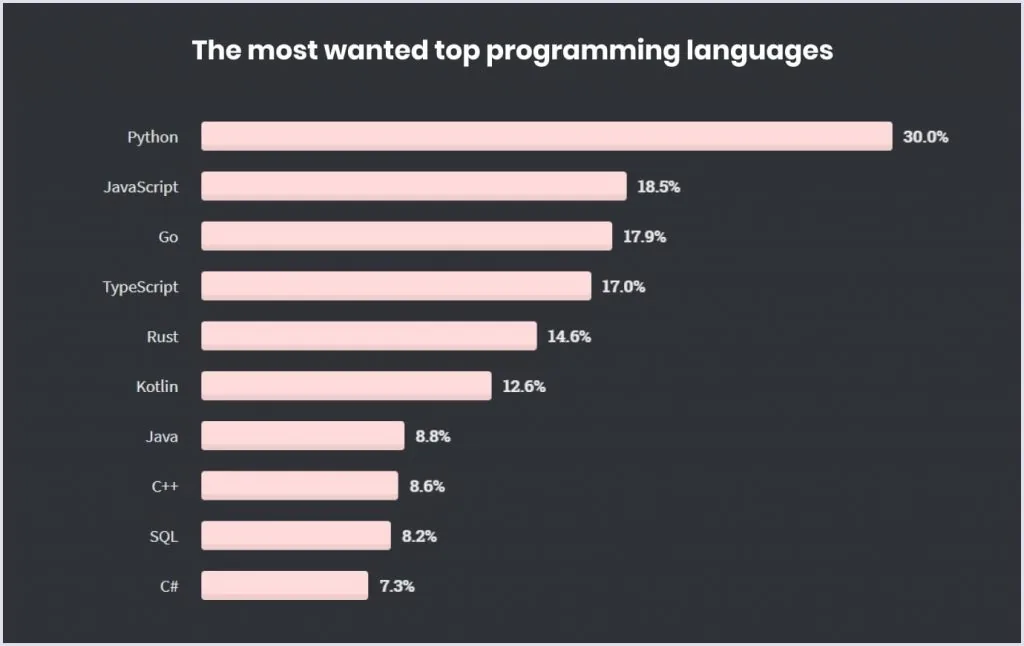
According to the survey by Stack Overflow, Rust is on the top five list of most wanted top programming languages:
One of the biggest questions developers have about Rust is whether the ecosystem is mature enough for serious game development. The answer is increasingly yes. Bevy, the most popular pure Rust game engine, has built a vibrant community and supports cross-platform development including iOS and Android. Bevy, Bracket-Lib, Fyrox, ggez;Macroquad; and Piston are the game engines written in Rust. In this section.The engine uses an Entity Component System architecture that scales well for complex games.
How Does Rust Impact Game Performance?
Mobile games demand efficient resource usage. Rust's zero-cost abstractions mean you can write high-level, expressive code without sacrificing low-level performance. The language's concurrency features let you write safe multithreaded code, essential for modern mobile games that need to handle rendering, physics, AI, and networking simultaneously without grinding to a halt.
Battery consumption is a critical metric for mobile games. Because Rust code is so efficient and runs without garbage collection pauses, games built with Rust tend to be kinder to device batteries. Players notice when a game drains their battery quickly, and they're more likely to uninstall it. Rust helps developers build games that perform well without being power-hungry.
What's It Like to Develop Games in Rust?
Learning Rust has a reputation for being challenging, and that reputation is somewhat deserved. The ownership system requires developers to think about memory management in ways they might not be used to. Once you grasp the concepts, many developers report that Rust's compiler becomes like a helpful pair programming partner, catching bugs before they become problems.
The development cycle in Rust for mobile games involves careful attention to the borrow checker, Rust's system for ensuring memory safety. While this can slow initial development, it dramatically reduces debugging time later. Studios that track metrics report spending significantly less time fixing crashes and memory issues compared to C++ projects.
Which Frameworks Work Best for Mobile?
Several Rust frameworks specifically target mobile game development. Bevy supports mobile platforms and continues adding mobile-specific features with each release. The engine's architecture makes it particularly well-suited for games that need to scale across different device capabilities.

For developers coming from Unity or Unreal, Godot with Rust bindings offers a familiar GUI-based workflow while letting you write performance-critical code in Rust. This hybrid approach lets teams leverage existing knowledge while gradually adopting Rust for the parts of their codebase that need maximum performance.
Macroquad provides a lightweight option for developers who want to build games quickly without the overhead of larger engines. Its simplicity makes it excellent for mobile games where you need tight control over performance but don't want to build every system from scratch.
Read More
What Are the Drawbacks?
The ecosystem is still maturing, and you won't find the same breadth of tutorials, asset stores, and third-party tools that Unity or Unreal offer. Some specialized game development tools and libraries haven't been ported to Rust yet, which can mean building your own solutions or wrapping existing C++ libraries.
Team training is a real consideration. If your team is experienced in C++ or C#, there will be a learning curve as they adapt to Rust's way of thinking about memory and ownership. Studios report that retraining core engine teams takes about six months, though the investment pays back through reduced debugging time.
Integration with existing codebases requires careful planning. If you have significant amounts of C++ code, interfacing with Rust through Foreign Function Interface boundaries adds complexity. However, this hybrid approach lets you adopt Rust incrementally rather than rewriting everything at once.
What Does the Future Hold?
SlashData's Developer Nation survey showed the Rust community doubled from 2 million developers in Q1 2022 to 4 million in Q1 2024.
The trajectory for Rust in mobile game development looks promising. As the language matures and more success stories emerge, adoption will likely accelerate. Industry trends suggest we're at an inflection point. More developers are experimenting with Rust, more engines are adding Rust support, and more games built with Rust are reaching players.
For developers starting new mobile game projects today, Rust represents a compelling choice. While established engines like Unity and Unreal still dominate and have their place, Rust offers a path to games that are faster, more stable, and more efficient on mobile hardware.
Partner with CodeSuite for Your Mobile Game Development
If you're looking to use Rust's power for your next mobile game project, CodeSuite offers best rust application development services with expertise. Our team specializes in building scalable mobile games for both iOS and Android platforms, combining modern development practices with proven methodologies.
With CodeSuite, you gain access to dedicated teams that understand the unique challenges of mobile gaming and deliver solutions that maximize engagement, performance, and player retention.
Frequently Asked Questions
Q1: Is Rust faster than C++ for mobile game development?
Rust matches C++ in raw performance while providing better memory safety guarantees. Benchmarks show comparable execution speeds, but Rust eliminates entire classes of bugs at compile time, potentially making development cycles faster overall.
Q2: Can I build a complete mobile game entirely in Rust?
Yes, frameworks like Bevy, Macroquad, and Fyrox support full mobile game development for iOS and Android. However, the ecosystem is still maturing compared to established engines like Unity or Unreal.
Q3: How long does it take to learn Rust for mobile game development?
Developers typically need 3-6 months to become comfortable with Rust's ownership system and borrow checkers. Those with C++ experience may adapt faster, though Rust's paradigms require adjusting your mental model of memory management.
Q4: Does Rust work on both iOS and Android?
Absolutely. Rust has excellent cross-platform support and can compile native code for both iOS and Android, allowing you to share core game logic across platforms while optimizing platform-specific features.
Q5: What types of games is Rust best suited for?
Rust excels in performance-critical games like action games, real-time multiplayer experiences, physics-intensive simulations, and battery-conscious mobile titles. It's particularly valuable when stability and consistent frame rates are essential.
Q6: Are there any successful mobile games built with Rust?
Yes, Facepunch Studios officially announced Rust Mobile in 2024, and several indie developers have shipped successful mobile titles using Rust frameworks. The ecosystem is growing with more production releases each year.
Q7: How does Rust impact mobile app battery consumption?
Rust's efficient memory management and lack of garbage collection reduce CPU overhead, which directly translates to better battery performance compared to languages that require runtime memory management.
Q8: Can I integrate Rust with my existing Unity or Unreal project?
Yes, both engines support integration with native code. Epic Games announced Rust integration for Unreal Engine 6, and Unity projects can call Rust libraries through native plugins, allowing incremental adoption.